The urge to leave a mark, to record thoughts, stories, and transactions, is deeply embedded in the human experience. Long before complex societies emerged, our ancestors scratched symbols onto cave walls and bone. But the journey from these primal marks to the sleek keyboards beneath our fingertips today is a fascinating story of innovation, driven by the constant need for faster, clearer, and more permanent communication. Our tools haven’t just changed how we write; they’ve subtly reshaped how we think and interact with information.
Echoes from Antiquity: Before the Feather
While our focus often jumps to the familiar quill, it’s worth remembering the writing implements that came before. Ancient civilizations relied on what their environment offered. Mesopotamians pressed wedge-shaped styluses into wet clay tablets, creating cuneiform script – durable records, but hardly portable. Egyptians used reed pens, fashioned from marsh grasses, to apply ink to papyrus scrolls. These early tools required skill and patience, and the materials themselves often dictated the form of the writing.
The Reign of the Quill
For well over a millennium, from roughly the 6th century until the 19th century, the quill pen dominated the world of writing in the West. Typically crafted from the flight feathers of large birds like geese or swans, the quill was both remarkably effective and demanding. Preparing a quill wasn’t a simple matter; the tip had to be carefully hardened, shaped, and slit with a penknife – a skill that required practice. This ‘nib’ would wear down quickly, necessitating frequent re-sharpening, hence the enduring association of writers with penknives.
Writing with a quill was an intimate, tactile experience. The angle of the nib against the parchment or paper, the pressure applied, the flow of ink (often homemade iron gall ink, which chemically bit into the paper) – all contributed to the character of the script. It was messy, required constant dipping into an inkwell, and was prone to splatters and blots. Yet, it was the tool that penned countless historical documents, literary masterpieces, and personal letters. The flexibility of the quill tip allowed for expressive, varied line widths, contributing to the beauty of calligraphy.
The Steel Point Revolution
The Industrial Revolution, unsurprisingly, brought change to the writer’s desk. While attempts at metal pen points existed earlier, it was the 19th century that saw the mass production of affordable, durable steel nibs. John Mitchell is often credited with pioneering machine-made steel points in Birmingham, England, around 1822. These ‘dip pens’ offered several advantages over the quill: they lasted much longer, provided a more consistent line, and eliminated the need for constant sharpening.
Suddenly, writing became slightly less laborious. Different nib styles emerged, catering to various tasks – fine points for detailed work, broader tips for bolder script. While still requiring dipping in ink, the steel nib democratized writing to some extent, making a reliable writing tool more accessible. Schoolchildren, clerks, and authors alike adopted the steel pen, though some traditionalists clung to the familiar feel of the quill.
The Quest for Self-Containment: The Fountain Pen
The constant dipping associated with both quills and steel nibs remained an inconvenience. Inventors dreamed of a pen that carried its own ink supply. Early attempts were often leaky, unreliable contraptions. The challenge lay in regulating the ink flow – ensuring enough ink reached the nib to write smoothly, but not so much that it flooded the page.
Significant breakthroughs occurred in the late 19th century. Lewis Waterman’s invention of a practical feed system in 1884 is a landmark moment. His design used capillary action to provide a controlled, steady ink flow, leading to the first truly reliable fountain pens. Other innovators like George S. Parker followed, refining designs and introducing features like leak-resistant caps and filling mechanisms (levers, buttons, pistons).
The fountain pen was a game-changer for portability and convenience. Writers could now carry their pens anywhere, without needing a separate inkwell constantly at hand. It became a status symbol, a personal item often crafted from fine materials. While more expensive initially than dip pens, their practicality ensured widespread adoption, especially among professionals and avid writers.
The invention of the reliable fountain pen significantly increased the portability of writing. This allowed professionals, students, and travelers to write more easily outside of a dedicated desk space equipped with an inkwell. It marked a major step towards writing becoming a truly mobile activity. The convenience factor played a huge role in its rapid adoption despite early costs.
Mass Writing: The Ballpoint’s Arrival
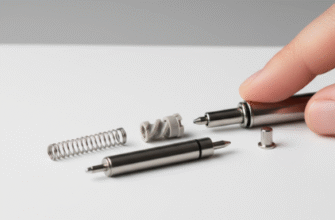
While the fountain pen offered elegance and convenience, it still used liquid ink that could smudge and required relatively smooth paper. The next great leap came from an unexpected direction, driven by a desire for ink that dried quickly on newsprint. Hungarian journalist László Bíró, frustrated with fountain pen smudges, noticed that the ink used in newspaper printing dried rapidly. Working with his brother György, a chemist, he developed a new pen design using a tiny rotating ball bearing in the tip.
This ball would pick up a thicker, oil-based ink from a reservoir and roll it onto the paper, where it dried almost instantly. Patented in the late 1930s, the ballpoint pen faced initial hurdles but gained prominence during World War II, as pilots needed pens that wouldn’t leak at high altitudes. After the war, mass production techniques brought the price down dramatically.
The ballpoint pen, particularly exemplified by Marcel Bich’s Bic Cristal launched in 1950, truly democratized writing. It was cheap, reliable, worked on almost any paper surface, didn’t leak easily, and lasted a long time. It became ubiquitous, found in every home, office, and schoolbag. While perhaps lacking the expressive flair of a quill or fountain pen, its sheer practicality made it the dominant writing tool for decades.
The Mechanical Word: Enter the Typewriter
Parallel to the evolution of handheld pens, another revolutionary invention was taking shape: the typewriter. Early concepts existed, but the first commercially successful typewriter, the Sholes and Glidden “Type-Writer” (which introduced the QWERTY keyboard layout), appeared in the 1870s. Initially cumbersome and expensive, typewriters gradually transformed business correspondence.
Typing offered legibility and speed that handwriting couldn’t match, especially for multiple copies using carbon paper. The rhythmic clatter of keys became the soundtrack of the modern office. It standardized the appearance of documents and arguably influenced a more concise writing style. While initially used primarily by professionals, portable models eventually brought typewriters into homes, used for letters, schoolwork, and creative writing.
Electric typewriters arrived later, reducing the physical effort required to press the keys and increasing typing speed further. They represented the peak of mechanical writing technology before the next major shift.
The Digital Revolution: Word Processors and Keyboards
The advent of computers heralded the most profound change in writing technology since the invention of the printing press. Early computers were not primarily writing machines, but the development of word processing software in the latter half of the 20th century changed everything. First appearing on dedicated word processor machines and then migrating to personal computers, this software offered unprecedented flexibility.
The ability to easily edit, delete, copy, paste, and format text without needing to retype entire pages was revolutionary. Mistakes could be corrected instantly. Drafts could be endlessly revised. Spell-checking and grammar tools emerged, further altering the writing process. The physical act of writing became separated from the final output in a way never before possible.
The primary interface for this new way of writing became the keyboard, a descendant of the typewriter layout, paired with a screen. Keyboards themselves evolved – from clunky mechanical switches to quieter membrane designs, ergonomic layouts, and wireless connectivity. The feel of typing, the sound of the keys (or lack thereof), became the new sensory feedback for writers.
Writing Today and Tomorrow
Today, most writing happens digitally, via keyboards on laptops, desktops, tablets, and smartphones. The keyboard remains dominant, but it’s not the only player. Touchscreen keyboards allow for writing on the go, albeit with a different tactile experience. Voice dictation software is increasingly sophisticated, translating spoken words directly into text, offering an alternative for speed or accessibility.
Looking ahead, technologies like gesture control or even brain-computer interfaces hint at future possibilities where the physical tool might become less prominent, or even disappear entirely. Yet, the fundamental need remains: to capture thought and communicate.
From the carefully sharpened quill tracing ink across parchment to the rapid tap of keys on a screen, our writing tools have profoundly shaped our relationship with language and information. Each innovation solved problems of its predecessor, often introducing new possibilities and subtly influencing how we compose, edit, and share our words. The evolution continues, but the long journey from feather to pixel highlights our enduring quest to make the expression of ideas ever more fluid and efficient.
“`